
DATA CENTER POWER INFRASTRUCTURE ENGINEERING
ENGINEERING THE GRID CONNECTIONS THAT POWER THE DIGITAL ECONOMY
Hyperscale data centers, colocation facilities, and artificial intelligence computing campuses are among the most demanding power consumers ever connected to the electric grid. A single hyperscale facility can require 100 to 500 megawatts of new load — equivalent to the peak demand of a mid-sized city — and must receive that power with the reliability, power quality, and redundancy that mission-critical operations demand. The engineering required to connect, deliver, and distribute power at that scale is not standard utility infrastructure work. It requires deep technical expertise in high-voltage interconnection design, generation integration, campus-level distribution architecture, and the utility new service processes that govern how large loads are added to the grid.
Tangibl Group provides engineering and regulatory services for data center power infrastructure across the full range of voltage levels and project types — from preliminary interconnection studies, substation and switchyard design to generation tie line engineering, campus distribution systems, and utility new service coordination. Tangibl has supported new service requests and transmission and substation engineering for several data center sites across the PJM footprint, with additional sites under development in Texas, Utah, and other regions beyond PJM. Tangibl works primarily with data center developers, data center owner-operators, and their partners to support grid interconnection and co-located power generation development — and we bring the same on-site engagement and technical depth to data center power infrastructure that we deliver across our utility engineering practice.
The scale of demand growth in this sector is unlike anything the power industry has encountered in the modern grid era. Tangibl is currently providing engineering support for data center sites with individual capacities in excess of 2 GW, with project development pipeline activity supporting sites approaching 5 GW in aggregate capacity, including both behind-the-meter and grid-connected data centers. These are not incremental load additions — they are new grid-scale infrastructure challenges that require the full range of Tangibl’s technical, regulatory, and commercial capabilities.
INTERCONNECTION SWITCHYARDS
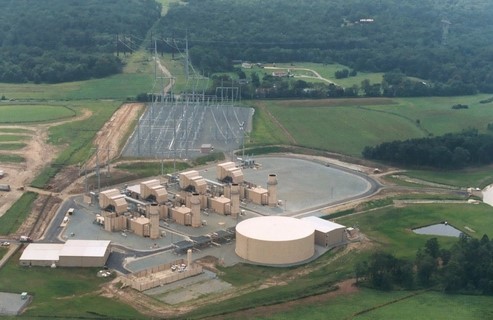
The interconnection switchyard is the technical and commercial gateway between the electric transmission system and the data center’s internal power infrastructure. At the power levels required by hyperscale and AI computing facilities, switchyard design is high-stakes engineering — errors in protection scheme design, bus configuration, or equipment ratings have consequences that extend to the reliability of the regional grid, not just the facility itself. Additionally, some large-scale data centers require on-site regional substations. It is of critical importance that the land development plans include all required assets for proper interconnection.
Tangibl provides detailed engineering for interconnection switchyards serving data center and large-load applications at 69 and 138kV, with preliminary engineering experience for 115 kV, 138 kV, 230 kV, 345 kV, and 500 kV utility substations to establish land requirements, electrical configuration, and to assist clients in obtaining service commitments from the local transmission owner. Our substation engineering team designs switchyards from preliminary concept through issue-for-construction work packages, applying the same protection engineering rigor and equipment specification discipline that we bring to our transmission utility substation practice.
Depending on the project, Tangibl serves either as the engineer of record preparing detailed design packages for construction, or as Owner’s Engineer reviewing and overseeing an EPC contractor’s design. In both roles, our substation engineering team’s depth of experience in transmission-level protection and control is the critical differentiator.
Our interconnection switchyard engineering services include:
- Preliminary and detailed one-line diagram development across multiple voltage levels and bus configurations
- Protection and control scheme design, relay selection, and relay settings calculations
- Bus configuration analysis — single bus, main-and-transfer, ring bus, breaker-and-a-half — matched to reliability and operational requirements
- Equipment specification for power transformers, circuit breakers, disconnect switches, surge arresters, and control equipment
- Civil and structural engineering coordination for switchyard layout and equipment foundations
- SCADA and communications integration design
- Interconnection agreement technical exhibit support and transmission owner coordination
GENERATION TIE LINES
Data centers and large-load campuses increasingly require dedicated generation tie lines connecting co-located onsite generation — most commonly natural-gas-fired reciprocating engine arrays — to the customer switchyard. These lines must be engineered to meet both the technical performance requirements of the data center’s critical power architecture and the interconnection standards of the transmission owner, and they must be designed in coordination with the switchyard protection scheme to ensure coordinated fault clearing.
Tangibl provides engineering for generation tie lines connecting co-located gas-fired reciprocating engine plants and battery energy storage systems to data center customer switchyards. Our transmission engineering team draws on deep experience in line terminal relay replacement and protection scheme design from 34.5 kV to 345 kV applications to deliver generation tie line designs that are technically correct, constructible, and compliant with applicable interconnection standards.
Our generation tie line engineering services include:
- Routing analysis and right-of-way coordination support
- Preliminary and detailed transmission line design — structure selection, conductor sizing, clearance calculations
- Protection scheme design for line terminal relay applications, coordinated with switchyard protection
- Interconnection facilities study support and technical exhibit preparation
- FAC-008 facility ratings analysis for new line segments
- Underground transmission cable design where routing or environmental constraints require it, including thermal rating studies
CAMPUS DISTRIBUTION SYSTEMS

The campus distribution systems serving the data center facilities Tangibl supports operate at transmission voltage — 69 kV to 138 kV — because the MW capacity requirements of individual data center buildings at hyperscale are such that medium-voltage distribution architectures cannot deliver the required power density. This is a fundamental difference between data center campus distribution engineering and conventional industrial or commercial distribution design, and it requires engineers who are equally fluent in transmission substation design and distribution system architecture.
Tangibl’s campus distribution work is behind the utility interconnection point and downstream from co-located generation, encompassing the electrical infrastructure that routes power from the transmission interconnection and onsite generation sources to each building on the campus. Our substation engineering team’s experience designing everything from 13kV to 138kV systems for electric utilities (and up to 500kV for IPP interconnections) translates directly to this environment, where the reliability standards for mission-critical computing loads are comparable to or more demanding than utility transmission standards.
Our campus distribution engineering services include:
- 69 kV or 138 kV transmission-level campus distribution system design for high-density data center loads
- Unit substation specification and one-line diagram development
- Protection and control scheme design for campus distribution feeders
- Grounding system design and ground potential rise analysis
- Conduit and duct bank routing design for underground campus distribution
- Short-circuit analysis and protective device coordination studies
- Load flow analysis to verify voltage and thermal performance under normal and N-1 contingency conditions
UTILITY NEW SERVICE REQUESTS
Connecting a hyperscale data center to the electric grid requires navigating a utility new service process that is rarely designed for loads of this magnitude. For loads greater than 100 megawatts, a standard commercial new service request is not sufficient. The engineering and regulatory work that must accompany a large-load new service request — load ramps, load flow studies, protection coordination analysis, customer and utility substation layout and preliminary design, system impact studies, and substation capacity assessments — requires the same level of technical rigor as a new generation interconnection.
Tangibl assists data center developers in navigating the utility new service request process, including load ramp block scheduling, project timing, and site layout coordination to accommodate both the data center campus and the utility interconnection switchyard. Tangibl has supported new service requests for individual data center sites with capacities over 2 GW — among the largest large-load interconnection engagements in the current market — with project development pipeline activity approaching 5 GW in aggregate across multiple sites.
Our utility new service support services include:
- Preliminary load flow and system impact analysis to identify network upgrade requirements early in the development process
- Technical exhibit preparation for new service applications — load characteristics, power factor requirements, harmonic content, ramp profiles
- Site layout coordination integrating data center campus design with utility switchyard requirements
- Coordination with the serving utility’s engineering team on study scope, assumptions, and methodology
- Review and technical assessment of utility-issued system impact study results
- Cost exposure analysis and negotiation support for utility-required network upgrades
- Regulatory support for large-load interconnection proceedings before state commissions or FERC

THE TANGIBL APPROACH TO DATA CENTER POWER INFRASTRUCTURE
The power infrastructure challenges facing data center developers are not generic utility engineering problems. They require engineers who understand both the technical requirements of mission-critical power delivery and the interconnection, regulatory, and commercial frameworks that govern how large loads connect to and interact with the electric grid.
Tangibl understands not just the technical requirements of a data center with respect to utility interconnection, but also the evolving regulatory environment at PJM and FERC — including Connect and Manage, co-located load rules, and related FERC proceedings — and the project economics of power generation development. That combination is what our clients need and what most engineering firms cannot provide.
-Wade Horigan, Principal & Manager of Business Development, Tangibl Group
This combination of engineering depth, regulatory expertise, and project development experience is what allows Tangibl to support data center clients from initial site assessment through interconnection agreement execution and detailed design. Our engineers have designed transmission substations, distribution systems, and protection schemes across hundreds of projects for electric utilities operating in PJM and other major markets. We understand how utilities evaluate large-load new service requests, what their engineering standards require, and how to work productively within their study and approval processes. And we bring that knowledge to the data center developer’s side of the table — helping projects move from site acquisition and interconnection inquiry through engineering and utility approval more efficiently than teams that lack direct utility-side experience.
CASE STUDY
New Service Request Support and Transmission Engineering — Multiple Sites Across the US
Tangibl is currently providing new service request support and transmission and substation engineering for a data center owner-operator with multiple active sites in PJM, with additional sites pending acquisition in regions outside PJM. Simultaneously, Tangibl is providing new service request support and transmission and substation engineering for data center developers for sites in several jurisdictions across the US. These engagements span individual site capacities over 2 GW and support a project development pipeline approaching 5 GW in aggregate load.
REQUEST INFORMATION
If you have a project that you believe is a good fit for our capabilities, please contact us. We can schedule an exploratory conversation to better understand your needs and together determine how best to serve you.
DATA CENTER POWER INFRASTRUCTURE — FREQUENTLY ASKED QUESTIONS
What engineering is required to connect a hyperscale data center to the transmission grid?
Connecting a 100 to 500 megawatt data center to the transmission system requires interconnection switchyard engineering, protection scheme design, load flow and short-circuit analysis, and coordination with the transmission owner’s interconnection process. Depending on the project, this may also include generation tie line design if the data center is co-locating onsite generation, campus distribution system engineering at 138kV or other transmission voltage levels, and FAC-008 facility ratings studies. The process typically involves a formal new service request and one or more transmission system impact studies, the results of which determine the scope of network upgrades required before the load can be served.
How long does the utility new service process take for a large data center load?
For large loads in the 100MW and above range, the utility new service and interconnection study process is substantially more complex than standard commercial new service. Study timelines vary significantly by utility and ISO/RTO, but data center developers should plan for a process that takes 12 to 36 months from initial new service inquiry to execution of an interconnection or large-load service agreement — longer if significant transmission or substation upgrades are required. Early engagement with experienced engineering and regulatory support significantly reduces the risk of study delays, scope surprises, and cost allocation disputes.
Can a data center interconnect with onsite generation to reduce dependence on the utility grid?
Yes, and this approach is increasingly common for hyperscale and AI computing facilities with very high reliability requirements. Onsite generation — particularly natural-gas-fired reciprocating engine arrays, which can start and reach full output within minutes — can provide backup capacity, reduce peak demand from the grid, and in some configurations provide black-start capability. Connecting onsite generation to the campus distribution system and to the utility grid interconnection point requires generation tie line engineering, switchyard protection coordination, and compliance with the transmission owner’s and ISO/RTO’s interconnection requirements. Tangibl provides engineering across all of these elements, and our regulatory team has direct experience with PJM and FERC proceedings governing co-located load and generation interconnection.
How long will it take to get a load-serving commitment from the utility?
The timeline for a utility load-serving commitment varies significantly based on the size of the load request, the transmission owner’s study queue, and the scope of network upgrades identified in the system impact study. For large data center loads, developers should engage with the utility’s engineering team and the relevant ISO/RTO process as early as possible — ideally concurrent with or before site control is established. Tangibl can provide preliminary load flow and network impact analysis during the site evaluation phase to help developers assess the feasibility of a load-serving commitment before significant capital is deployed on site acquisition and development.
What is a developer’s cost exposure to the utility for reliability violations identified in system impact studies?
When a utility’s system impact study identifies reliability violations driven by a new large load, the cost of the required network upgrades is typically allocated to the requesting developer under cost allocation frameworks established by the transmission owner’s tariff and applicable ISO/RTO rules. The magnitude of these costs can range from modest substation modifications to major transmission line and substation construction projects costing tens or hundreds of millions of dollars. Tangibl provides cost exposure analysis during the pre-application and study phases to help developers understand their potential upgrade cost exposure, evaluate site alternatives, and negotiate cost allocation outcomes within the applicable regulatory framework.